Making sure people are still good people
Redesigning the KYC Experience
Beam's mission is to prevent large-scale criminal activity through continuously evolving intelligence. I led the redesign of the KYC experience, fulfilling another large pillar of the product.
- Company
- Beam Solutions
- Year
- 2022
- Role
- Product Designer
- Focus
- Identity VerificationFraud InvestigationAnti-Money Laundering
Background
Beam builds anti-money-laundering software for banks and fintechs. US regulatory requirements boil down to two obligations: monitoring transactions for suspicious activity, and knowing who your customers are before you do business with them.
Compliance Definitions
- KYC / CDD
- Know Your Customer and Customer Due Diligence: background checks that assess the risk a customer poses before onboarding them.
- EDD
- Enhanced Due Diligence: a deeper investigation triggered when a customer shows elevated risk.
- ODD
- Ongoing Due Diligence: periodic re-review of existing customers as their behavior and risk profile change.
An MVP existed before my time at Beam, so the product team shared previous insights and findings. As with any new project, we met to lay out the problems and goals we wanted to tackle.
Problem
Analysts need a means to efficiently complete KYC investigations that have different requirements based on their organization's KYC policy.
- Onboarding always involves ID/document verification, currently done manually by the analyst
- An analyst may go through many cases a day, not all of which require deeper investigation, but all are blocked until manually cleared
- The current UI provides no clear directive on what must be done to move a case forward
The stakes were operational as much as regulatory. Talking with the product team and our design partners, we estimated analysts were working through 60 to 80 KYC cases a day, and every one of them sat blocked until someone manually cleared it. For our customers that meant slower onboarding of their own users; for Beam it was the gap between an MVP and a product that could anchor enterprise deals.
Mission
Create a more robust KYC product that lets compliance teams onboard new customers and review existing customers' risks by leveraging our machine learning engines, and make it clear what needs to be investigated based on the organization's policies.
- Create a new type of case for customer due-diligence built on a checklist paradigm
- Generate the checklist from configured rules dictated by the organization's KYC policy
- Leverage a 3rd-party integration to automate identity verification via customer-provided documents
- Show which transaction triggered the case and how case outcomes affect that transaction (blocked, approved)
We also agreed with Product on how we would judge the redesign once live:
- Time to clear a case
- Median time from opening a KYC case to a decision, especially for the cases that carry no real risk.
- Auto-clear rate
- The share of cases the system clears without an analyst ever opening them, freeing time for real investigations.
Framing
A checklist generated by policy, not designed by hand
The core design idea was that the checklist could not be a static template. Every organization's KYC policy is different, so the checklist had to be generated from the rules an admin configures: which checks apply, at what risk thresholds, and what is allowed to clear automatically.
This model is also what made auto-clearing safe to propose. If every checklist item is satisfied by an automated check, the case never needs an analyst; it is cleared, recorded, and sampled later for quality control. Framing automation as the checklist completing itself made it legible to compliance stakeholders who are rightly suspicious of black boxes.
Kickoff
Flow charts & whiteboarding
I met with my design partner, Product, and Engineering to build consensus on how our systems handle KYC cases and how an analyst might work through them.
The design team brainstormed through collaborative wireframing on Whimsical, converging on two layouts: one a further departure from current case layouts, and another that stayed closer to them.
I created mid-to-high fidelity wireframes of both options in Figma to build prototypes and prepare for usability testing.
Research
User testing insights
Time constraints meant we couldn't enlist existing customers, so we ran guided usability sessions with 5 internal subject matter experts, former compliance analysts on our solutions team, walking each through prototypes of both layouts. Internal-only testing was a tradeoff we made for speed, and it still settled the layout question: the tabbed, checklist-first layout won for its clearer directive, even though it departed further from our existing case screens.
“If the case tells me exactly what's left to clear, I don't have to keep a mental checklist across a hundred cases. That's the whole job right there.”
Consistent access to customer information
Analysts need easy, consistent access to customer information to cross-check against screening hits such as watchlists, PEP, and negative news.
Notes and attachments everywhere
For regulatory purposes, analysts must be able to add notes and attachments to every item or at the case level, reflected in a timeline.
Every click counts
An analyst may go through hundreds of cases a day. One less click translates to hundreds of fewer clicks.
Final Designs
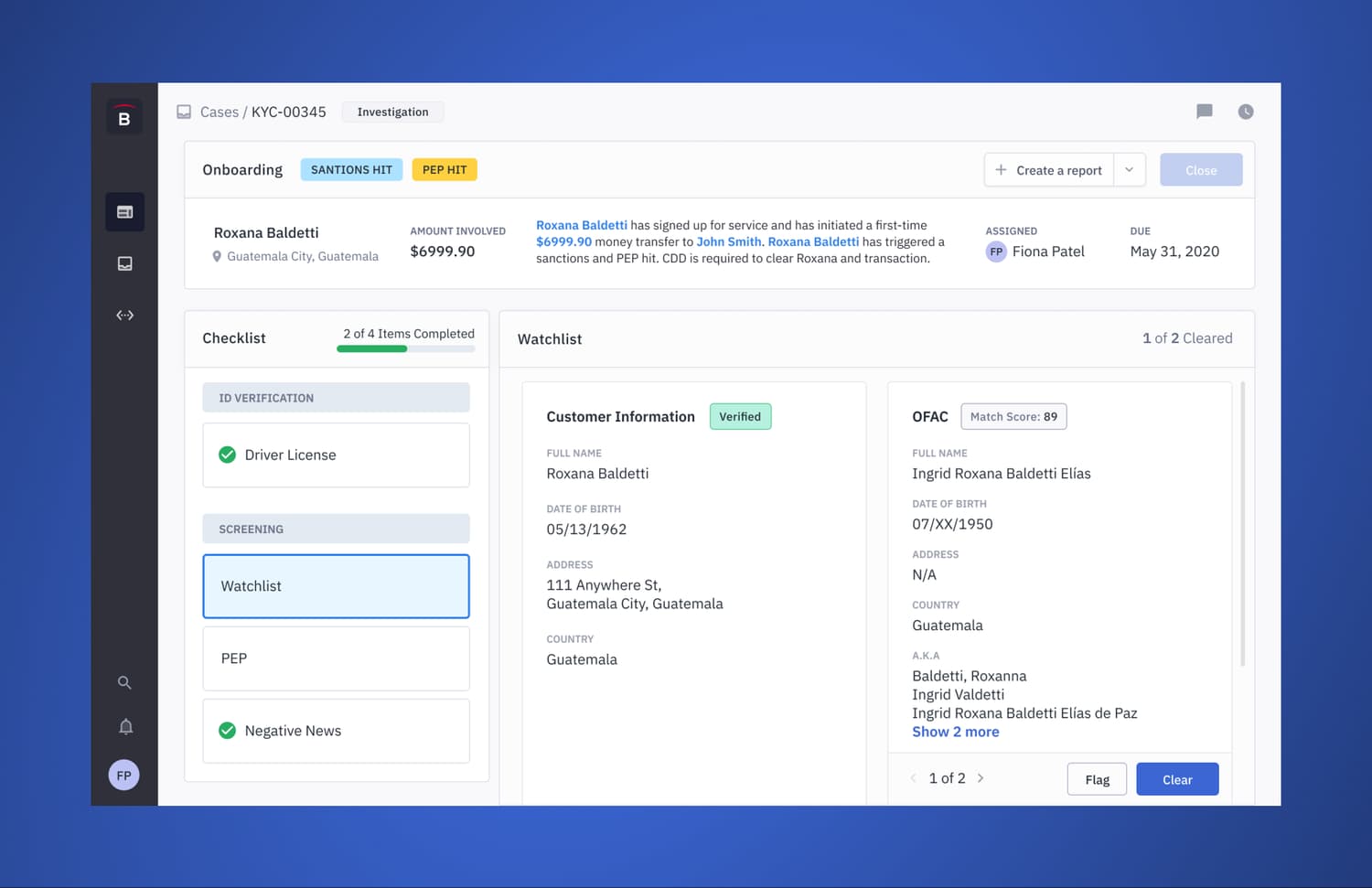
The new KYC case screen
A 3rd-party verification service verifies customer identity through documents provided by the customer, automatically clearing the appropriate checklist item when verification succeeds. Analysts can also manually upload documents for verification.
Analysts manually flag or clear watchlist and sanctions hits individually, while PEP data is retrieved from a 3rd-party service with all necessary information laid out to decide whether to flag or clear.
Once the checklist is complete, the analyst is prompted based on the state of the checklist items. Depending on the outcome, a regulatory report may be required; created reports appear as list items linking to the report page for filing.
Outcome
- 38%
- of KYC cases at early design partners auto-cleared end to end, with no analyst touch
- 60%
- fewer clicks to clear a routine case, measured against the old screen in prototype walkthroughs
We created a streamlined process that naturally leads the user toward what must be done to complete their investigation:
- A checklist paradigm helps the user investigate all required items to move the case forward: a clear directive
- Clear case actions and consequences, depending on checklist decisions, communicated through modals
- Cases where the customer can be automatically cleared of all checklist items are auto-cleared and saved in the system for ODD and QC spot-checking
As we moved toward shipping, design reviews with engineering surfaced many threads still to pull: ongoing due diligence, richer third-party data on case subjects, handling multiple parties in one case, and representing different kinds of KYC cases.