Setting up for success
Ingestion Mapping
Our portal lacked self-serve capabilities; new customers had to rely on Solution Engineers to ingest their data. I was tasked with a solution that makes it easy for customers to import, map, and display their data correctly within the portal.
- Company
- Jumio
- Year
- 2023
- Role
- Product Designer
- Focus
- Data Ingestion & MappingAdmin Settings
Problem
Customers were originally expected to work with our Solution Engineers (SEs) to ingest their data. That wasn't scalable, and we'd been making efforts to provide self-service tools to lessen the load on SEs.
Customers need a way to quickly and easily ingest and map their data on the Jumio portal in order to onboard and begin monitoring and investigations, without the hassle of reaching out to a Jumio SE.
Scale made this urgent. Each new customer consumed an estimated 10 to 15 hours of SE time across kickoff calls, sample file reviews, and rework, and ingestion was the longest stretch of onboarding: often two to three weeks before a customer saw their own data in the portal.
Goals
High-level goals
- 01
Self-serve from day one
Let a new customer generate an API key and start sending data without waiting on a Jumio SE.
- 02
Two ingestion paths
Support real-time ingestion through the API and batch files through SFTP, since customers' technical capabilities vary widely.
- 03
Data that reads like theirs
Let customers map fields, naming conventions, and formats so the portal speaks their internal vocabulary.
With Product we framed success around two measures:
- SE-free onboarding
- The share of new accounts completing ingestion and mapping without an SE session.
- Time to first data
- How long it takes a new customer to see their own records live in the portal.
Discovery
Understanding the process
The first step to creating a seamless experience is simply understanding the process. This involved meetings with product and engineering to understand what the customer needs and how each step connects, plus a knowledge base of existing documentation on successful data ingestion.
First Iteration
New settings pages
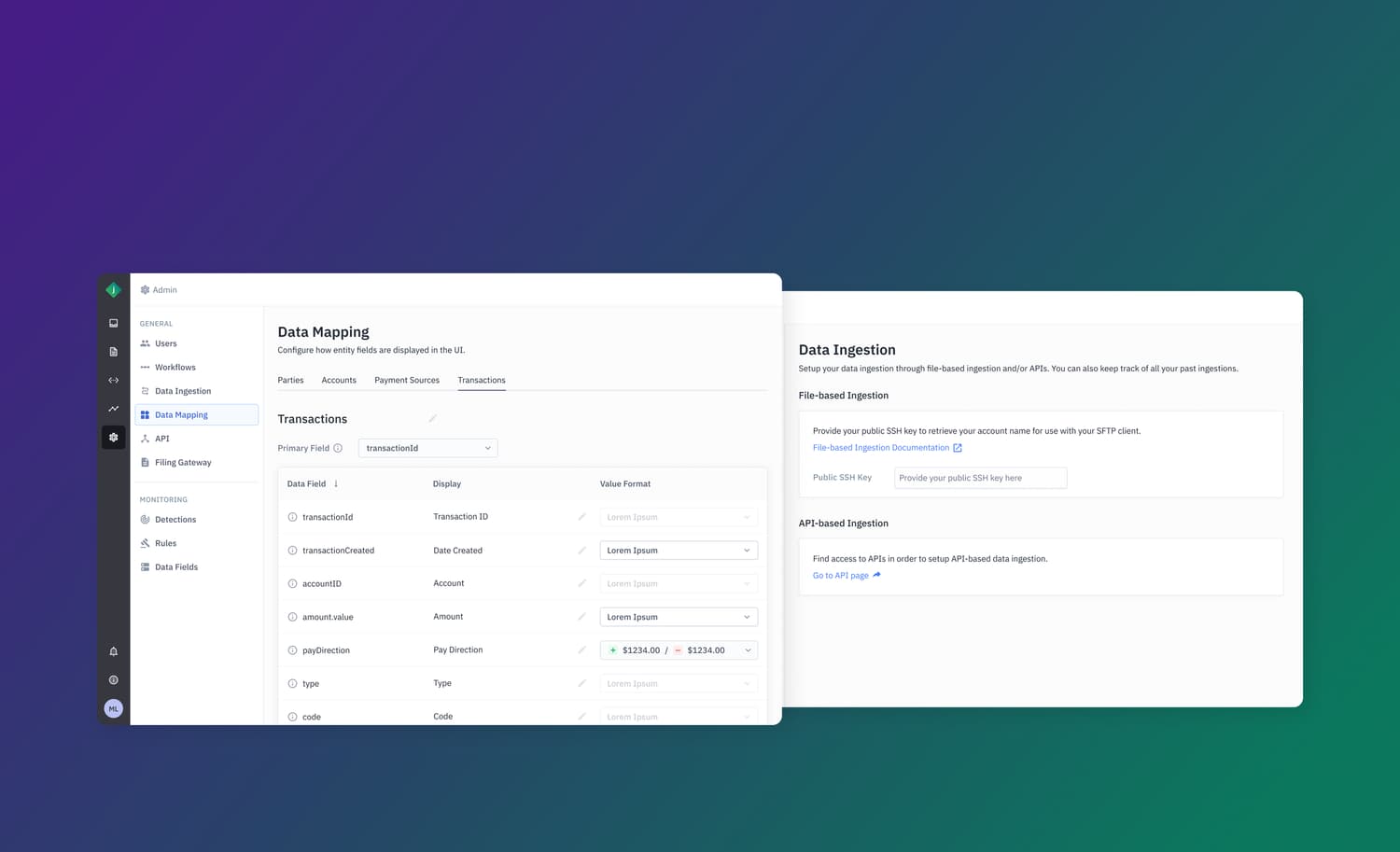
We added settings pages for API, Ingestion, and Mapping. For ingestion, I approached the design by understanding how it's done technically; the customer was expected to submit a JSON file in an expected format.
After ingesting data, users needed to customize the mapping of fields to fit their internal vocabulary and formats.
The API page started by simply giving customers a way to create an API key, along with the other endpoints they could utilize, plus links to the API documentation.
Feedback
Final iteration
I initially partitioned information under accordions, hoping to reduce visual clutter and direct the user toward the steps needed on each page. After discussion, it proved an unnecessary extra click to access information they'd need anyway, so I iterated to display all information and options upfront.
Accordions were unnecessary here, causing more disruption than the visual clutter they were meant to prevent.
Outcome
The business call was to skip formal validation testing and learn from production instead; the surface area was contained and internal alignment was strong. I pushed to make testing in production mean something: we tracked where customers stalled in setup and reviewed support tickets with the SE team in the months after launch.
- 70%
- of new accounts completed ingestion and mapping without an SE session in the first two quarters
- 3x
- faster time to first data in the portal for self-serve accounts, days instead of weeks
Design from the data contract
The ingestion UI only made sense once I understood the JSON contract and SFTP flow underneath it. Starting from the technical reality kept the design honest about what customers actually had to do.
Kill your own pattern
The accordion layout I was attached to lost to a flat page that showed everything upfront. Cutting my own idea on evidence, quickly and without ceremony, was the right call.
Scope validation into the MVP
Instrumentation and ticket reviews gave us a feedback loop, but they measure stumbles after the fact. Next time I would scope usability validation into the MVP rather than negotiating for it afterward.
There were also plans to expand this feature with custom field mapping and proxy assignment.